Tuesday, March 22, 2011

Brazilian Butt Lift ~ Houston Plastic Surgeons

The Brazilian Buttock Lift  

With the popularity of Jennifer Lopez, and Kim Kardashian's shapely buttock curvature, buttock augmentation has been reported to be one of the top cosmetic procedures predicted to increase in 2011 according to the American Society of Aesthetic Plastic Surgery.  Recently there has been an increasing demand of having a youthful, prominent and perky buttock to obtain a more sensual body profile. The classic hourglass shape (full buttocks, narrow waist) of the female body has been thought to be aesthetically pleasing, and is what men universally find most attractive according to one study.  Several types of augmentation, such as the breast and that of the buttock, have sprouted demand to help create this hourglass figure.  

L'Etoile Perdue: painted by William A. Bouguereau
 (File courtesy of Wikimedia Commons)
The buttock has been an important element of sexual attraction in essentially all cultures throughout recorded history.  Buttock augmentation can be performed by using several methods such as the insertion of silicone buttock implants; by rearranging muscle and fat from your buttock; and by injection using fat grafts.  The so-called "Brazilian Butt Lift" has been increasingly popular in the United States, especially since this buttock augmentation procedure does not involve placement of a buttock implant.  This particular procedure involves the harvest of fat from areas with excessive fat (such as the lower abdomen, flank and hips) by performing liposuction.  These fat grafts are then subsequently injected in areas of the buttock desired to be augmented in order to produce a more attractive and sensuous body profile.  Before one decides to partake and undergo this increasingly popular cosmetic procedure, one should be fully informed about this particular plastic surgery.

Fast Facts about Fat Grafting for Buttock Augmentation (Brazilian Butt Lift)

  • Liposuction is first performed in areas where there's excessive fat, such as the abdomen, flank, and hips (iliac crest area).
  • After the fat graft is harvested, it is then injected both intramuscularly (into the muscles) and subcutaneously (underneath the skin) at the desired area of the buttock to be augmented.
  • Approximately 300 to 400 mL of fat is injected on each side of the buttock.
  • The average fat injected may depend on the ethnicity of the patient (~205 mL in a petite Asian patient; 400 to 1430 ml per side in a Caucasian patient; 400 to 1478 mL per side in a Hispanic patient; and 400 to 1880 mL in an African American patient.)
  • The volume of fat that will be injected will depend on the amount of donor fat available.  Thus, patients with minimal fatty tissue may not be a candidate.
  • 50 to 75% of the fat grafted remains long term according to a clinical study involving 566 patients.
  • There may be lesser pain and faster recovery associated with the procedure, as compared to buttock implant placement, according to one study.


Potential Complications of Fat Grafting for Buttock Augmentation
  • Wound infection/Cellulitis (<2%)
  • Seromas/hematomas
  • Asymmetry
  • Fat necrosis
  • Fat embolism (rare)
  • Partial reabsorption of grafted fat
  • Transient sciatic paresthesias (numbness)

    Plastic surgery is a rapidly evolving field.  It is imperative to have a plastic surgeon, who have solid mastery of clinically relevant anatomy in aesthetic gluteal body contouring surgery, perform these emerging procedures of aesthetic plastic surgery.  Buttock augmentation using fat grafts may seem to be a simple procedure, but like any procedure, potential complications and adverse events may occur.  I recommend seeing a plastic surgeon in your community if one is interested in getting the "Brazilian Butt Lift."


      Emmanuel De La Cruz M.D.

      Recommended article:


      Reference:
      American Society of Aesthetic Plastic Surgery: 10 Cosmetic Plastic Surgery Predictions for 2011 
      Bruner, et al. Complications of Buttocks Augmentation: Diagnosis, Management, and Prevention.  Clinics in Plastic Surgery. 2006, Vol 33 (3): 449-466
      Centeno et al. Clinical Anatomy in Aesthetic Gluteal Body Contouring Surgery.   Clinics in Plastic Surgery. 2006, Vol 33 (3):347-358
      Roberts, et al. “Universal” and Ethnic Ideals of Beautiful Buttocks are Best Obtained by Autologous Micro Fat Grafting and Liposuction.  Clinics in Plastic Surgery. 2006, Vol 33 (3): 371-394
      Roberts, et al.  Augmentation of the Buttocks by Micro Fat Grafting. Aesthetic Surgery Journal. 2001, Vol 21: Part 4, pp311-319
      Singh, Devendra. Universal Allure of the Hourglass Figure:  An Evolutionary Theory of Female Physical Attractiveness.  Clinics in Plastic Surgery. 2006, Vol 33 (3): 359-370

      Friday, March 11, 2011

      The Effects of Smoking and Nicotine on Your Plastic Surgery

      The Effects of Smoking and Nicotine on Your Plastic Surgery

      Not only smoking been known to increase one's risk of developing lung cancer, chronic lung disease and coronary artery disease, but it also been found to hasten aging.  The risk of development of wrinkles at an earlier age is two to three times greater in smokers than non-smokers.  So does plastic surgery reverse the effects of aging among smokers?   Does smoking has any effects on your plastic surgical procedure?
       
      Fast Facts on Smoking and Plastic Surgery
      • Smoking one cigarette may cause the small vessels in your skin to constrict (vasoconstriction) for up to 90 minutes.  Thus, patients who undergo facelifts and other plastic surgery procedures, such as a breast lift, are at risk for necrosis of the skin.
      • Smoking a pack of cigarettes per day will remain tissue hypoxic (oxygen deprived) for most of the day.  Thus, it is critical to stop smoking before and after your plastic surgery procedure.
      • The nicotine in cigarettes causes constriction of the small blood vessels of your skin.  This leads to decreased delivery of oxygen to your skin.  
      • Thus, taking nicotine for smoking cessation would still have an adverse effect on tissue oxygenation after your plastic surgery procedure.
      • Nicotine impairs wound healing.
      Jessica Biel states that she does not smoke.  She'll likely maintain her youthfulness.

        Scientific Evidence of the Effects of Smoking on Wound Healing
        • Nicotine is associated with thrombosis of small vessels by interfering with prostacyclin activity.
        • Nicotine also retards the rate of wound epithelialization.
        • Nicotine decreases the proliferation of fibroblasts, which is an important part of wound healing.
        Smoking and Plastic Surgery
        • 40% of patients who smoke before and after breast reduction surgery had impaired wound healing in one study.
        • After breast reduction surgery, the risk of developing complications, such as inverted T-incision site necrosis, among smokers is doubled (odds ratio 3.1).
        • After breast reduction surgery, the infection rate (OR 3.3) was significantly elevated among active smokers.
        • In patients who undergo a facelift procedure, smokers present a 13-fold risk of skin necrosis.  
        • Smoking is also associated with an increased risk for the development of hematoma (bleeding) after a facelift surgery.
        • In patients who undergo transverse rectus abdominis myocutaneous flaps (TRAM flaps) for breast reconstruction, smoking is associated with significantly higher flap necrosis rates for smokers than nonsmokers (19% vs 9%, P=0.005). 
        As a physician and surgeon, I do not advocate smoking and highly recommend smoking cessation, especially if one is to undergo a surgical procedure.  One should avoid nicotine and smoking at least one month prior to undergoing plastic surgery in order to minimize potential complications that can occur after your surgical procedure. 
          Emmanuel De La Cruz MD

          References:
          Bartsch et al.  Crucial aspects of smoking in wound healing after breast reduction surgery. Journal of Plastic  Reconstructive Aesthetic Surgery. 2007;60(9):1045-9. Epub 2007 Mar 9.
          Grover, et al.  The prevention of haematoma following rhytidectomy: a review of 1078 consecutive facelifts.  British Journal of Plastic Surgery.  2001 Sep;54(6):481-6.
          Knobloch, et al.  Nicotine in Plastic Surgery: A Review.  Chirurg2008 Oct;79(10):956-62.
          Koh JS, et al. Cigarette smoking associated with premature facial wrinkling: Image analysis of facial skin replicas. International Journal of Dermatology. 2002;41:21.
          Krueger J, Rohrich RJ. Clearing the smoke: the scientific rationale for tobacco abstention with plastic surgery. Plastic  Reconstructive  Surgery. 2001 Sep 15;108(4):1063-1073. 
          Mosely, et al. Nicotine and its Effect on Wound Healing. Plastic  Reconstructive  Surgery. 1978 Apr;61(4):570-5.
          Siana JE, Rex S, Gottrup F. The effect of cigarette smoking on wound healing. Scandinavian Journal of Plastic Reconstructive Surgery & Hand Surgery. 1989;23(3):207-209

          Date Updated:  April 1, 2011

          Saturday, March 5, 2011

          Fat Grafting for Breast Enlargement/Augmentation

          The Use of Fat Graft for Breast Augmentation

          Fat grafting for breast enhancement has been thought to be a recent advancement for breast plastic surgery.  However, the concept of fat grafting was already pioneered in the late nineteenth century by Franz Neuber from Germany.  The idea of harvesting fat from areas where there's excess of fat (such as in the lower abdomen, hips or thighs), and using this fat for breast augmentation seems like a great idea.  Before one contemplates about fat grafting for breast enlargement, one should be fully informed about this procedure.

          Fast Facts about Fat Grafting for Breast Augmentation
          • Patients may need to use a device called the Brava device.
          • Patients typically use a Brava device 10 hours per day, generally overnight for several weeks before fat injection, and may need to use it for another 1-3 weeks or more. 
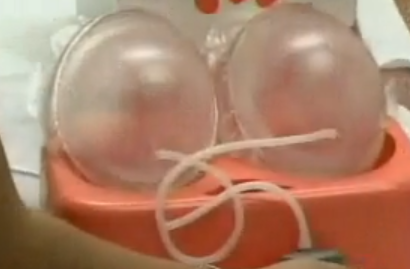
          • The Brava device is a plastic egg-shaped dome used to fit the patient’s breasts.  This is used to “create a gentle suction that stimulates tissue growth” per Dr. Khouri, inventor of the Brava device. 
          • The Brava device costs at least $800.
          • Multiple fat grafting may be required to cause a significant increase in breast size.
          • The fat graft volume retained one year after surgery ranged from 40 to 70% (average, 55%).

            Brava Device

            Advantages of Fat Grafting for Breast Enlargement
            • The main advantage of fat grafting into the breast is the avoidance of any complications associated with saline or silicone gel breast implants.
            • The augmented breasts may feel more soft and natural.
             Disadvantages of Fat Grafting for Breast Augmentation  
              • Only a moderate degree of augmentation is possible (possibly 1 cup size).
              • There is less projection of the breast with fat grafting when compared with a breast implant, but a more natural contour may be obtained with a fat graft.
              • The size of the fat grafted breast will likely decrease in size after 1 year.
              • The use of the Brava system for several hours per day before and after fat grafting of the breast may be too cumbersome for some patients.
              • The long term effects of injected fat into the breasts are still unknown and currently being studied.  
              • The injected fat could interfere with  mammogram readings, and thus may mask the ability to detect breast cancer.  However, a recent French study had shown no statistical difference in terms of breast density findings before and after fat injection. 
              Detection of Breast Cancer in a Fat Graft Augmented Breasts
              • The development of fat necrosis after fat transfer into the breasts may lead to formation of  liponecrotic cysts and microcalcifications..  
              • This may interfere with breast cancer screening.
              • Incidence of microcalcifications detected on mammograms ranged from 3.9 to 10%.
              • Incidence of fat necrosis ranged from 1.2 to 3%.
              • Incidence of liponecrotic cysts was 16.7% in one study.
              • A recent study showed that clustered microcalcifications, which are typically seen in a certain type of breast cancer (DCIS), was found in 16.7% of patients after fat injection for breast augmentation.  This clustered microcalcfication could not be distinguished from the mammographic findings typically seen in breast cancer.
              Who are the Best Candidates for Fat Grafting to Enlarge the Breast
                • Women who are breast reconstruction candidates including those who have been treated with radiation. 
                • Women who previously had breast reconstruction and would need revision breast surgery.
                • Women with mild breast asymmetry.
                • Women who are prepared to comply with strict peri-operative care and guidelines.


                As of January 2011, the "American Society for Aesthetic Plastic Surgery and the American Society of Plastic Surgeons, in the interest of patient safety, do not recommend fat grafting for breast enhancement at this time."  Currently, it has yet to be determined whether fat grafting has any potentiating effects on breast cancer.  The mammographic confusion differentiating between a benign and a malignant calcification still remains a problem after fat grafting for breast augmentation.  I recommend asking one of your plastic surgeons regarding fat graft injections for breast enlargement. 


                References:
                ASAPS Press Release: Fat Grafting for Breast Augmentation--What Women Should Know
                Illouz YG, Sterodimas A. Autologous fat transplantation 
                to the breast: a personal technique with 25 years of experience. Aesthetic Plast Surg 2009;33:706-715.
                Parrish et al. Autogenous fat grafting and breast augmentation: a review of the literature. Aesthet Surg J. 2010 Jul-Aug;30(4):549-56.
                Veber, et al.  Radiographic findings after breast augmentation by autologous fat transfer. Plast Reconstr Surg. 2011 Mar;127(3):1289-99.
                Yoshimura K, Sato K, Aoi N, et al. Cell assisted lipotransfer for cosmetic breast augmentation: supportive use of  adipose derived stem/stromal cells. Aesthetic Plast Surgery. 2008;32:48-55
                Wang, et al.  Clinical Analyses of Clustered Microcalcifications after Autologous Fat Injection for Breast Augmentation. Plastic & Reconstructive Surgery. 2011 May; 127: 1669-1673.
                Zocchi ML, Zuliani F. Bicompartmental breast lipostructuring. Aesthetic Plast Surg 2008;32:313-328.


                Date Updated: May 28, 2011

                Silicone Gel Breast Implant or Saline Breast Implant?